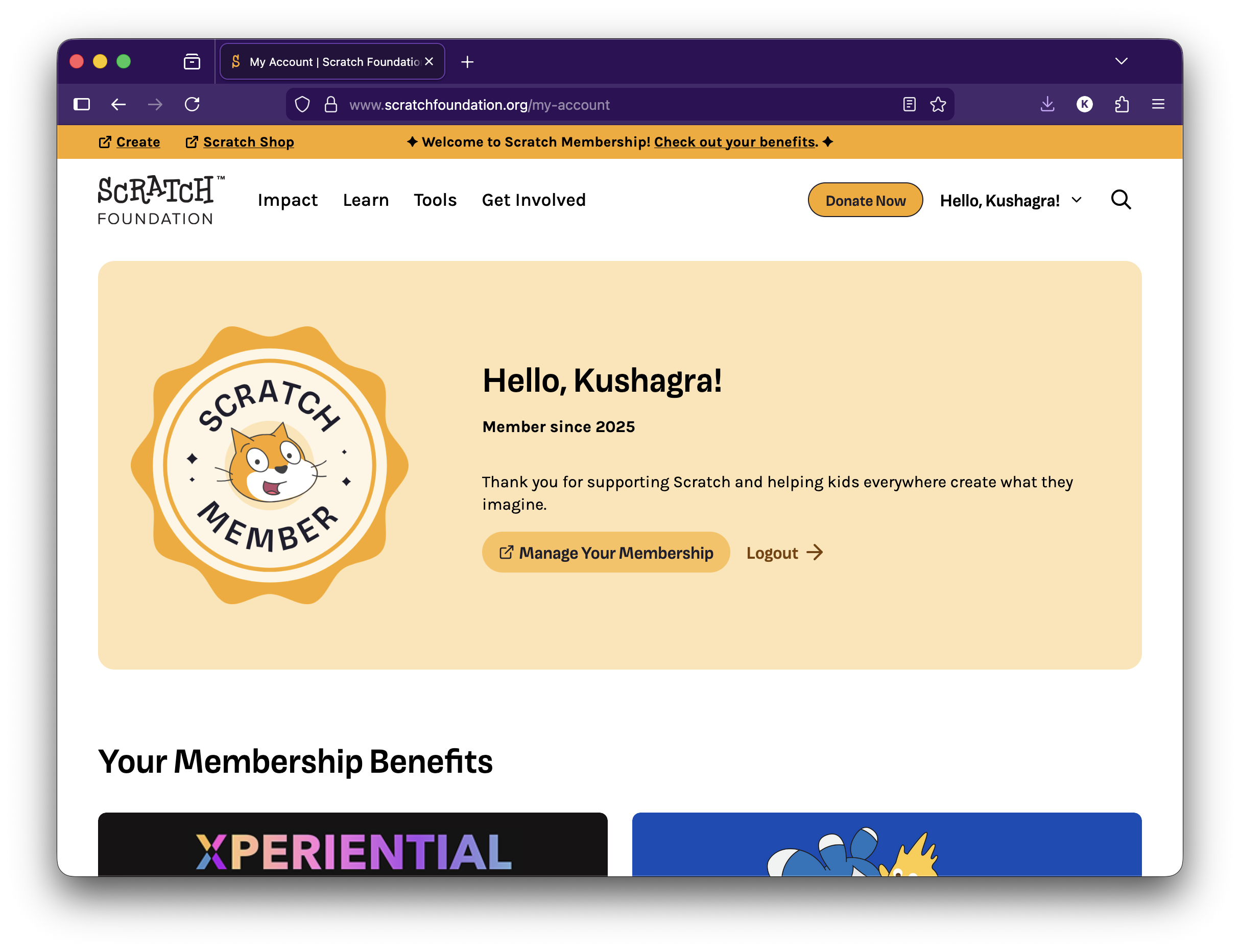
This is going to be a pretty short and compact note, but I wanted to put it out in the open that I now have the Scratch Lifetime Membership. For a program that I used way back in 2011, Scratch felt incredibly instrumental in my growth and development. This donation to the Scratch Foundation is just my token of thanks to the community.
Some Background
I’ve written before about how I got into this field. The short version: my first computer was a budget netbook with half a gig of DDR2 RAM and an Intel Atom processor that was slow as hell. Windows ran like garbage on it, which eventually pushed me toward Ubuntu, Bash scripting, and everything that followed.
But that post skipped over something important. Before I was installing Linux and learning the command line in 7th grade, I was dragging blocks around in Scratch in 5th grade.
Scratch 1.4, specifically. The desktop version, before it went browser-based. The one with the orange cat and the dark gray interface. I made little games—nothing impressive, just sprites moving around, responding to keypresses, playing sounds. I didn’t know I was learning programming. I just knew I was making things happen on screen, and it felt like magic.
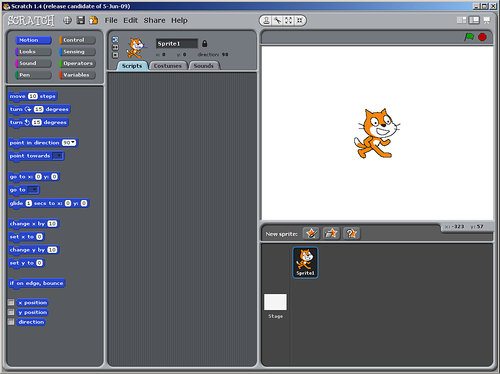
(The exact version of Scratch I used back then; and yes I was on Windows XP way until Windows 7 was mainstream, perhaps longer).
What Scratch Actually Teaches You
It’s hard to remember exactly what I learnt back then on Scratch. However, looking back, I think I have some takeaways:
Algorithmic thinking: You learn to break problems into steps. “I want the cat to walk across the screen” becomes “move right, switch costume, wait, repeat.” You’re decomposing problems before you know that’s a skill.
Cause and effect: Programs respond to things. Click the green flag, something happens. Press a key, something else happens. It’s the foundational idea that you can define what the computer does in response to events. That you can change things, that you can make the computer do what it wants to. Most product developers love to treat the idea of a computer as an “appliance”: that it does what it does and does not mess things up. Programming, even on Scratch, is the first exposure of a child’s imagination to the fact that the computer can morph into anything that you want, and that the sky’s the limit.
Creativity: Scratch gives you a canvas and a set of blocks. What you build is up to you. Games, animations, stories, music, art. The constraints (block-based, 2D, sprite-focused) don’t limit creativity—they channel it.
Articulation: To make something work, you have to be precise about what you want. “Make the cat jump” isn’t enough. How high? How fast? What happens when it lands? Scratch forces you to articulate your intent clearly, which is half of what programming actually is. Even then, your first attempt won’t work. You’ll tweak, test, tweak again. The feedback loop is instant—click the green flag and see what happens. This teaches you that building things is a process, not a single act.
The absence of syntax errors is pedagogically brilliant. The blocks either snap together or they don’t. You can’t misplace a semicolon or forget to close a bracket. This lets you focus entirely on logic—does my program do what I want it to do?—rather than fighting the tooling.
The Scratch Foundation Membership
The Scratch Foundation recently launched a membership program. There are two tiers:
- Lifetime Membership: $150 one-time (Founding Member pricing—this increases in 2026)
- Annual Membership: $35/year
Members get perks: exclusive sprite packs, editor themes (Cat Blocks turns hat blocks into cats, which is delightful), avatar frames, 10% off the Scratch Shop, access to Story Xperiential (a storytelling curriculum from Pixar/Khan Academy veterans at a massive discount), newsletters, webinars, and probably more stuff coming.
I am using exactly zero of these benefits. I just got married last year, and we don’t have any kids yet (for at least the next couple of years). I’m not making Scratch projects. This was purely a donation.
Why I Did This
I’ve never been the type to donate impulsively. I sometimes give $5 to Wikipedia because it’s load-bearing infrastructure for my entire intellectual life, and that’s about it. I think twice about most purchases.
But Scratch earned this.
The throughline from dragging blocks around on a budget netbook in 5th grade to hiding Christmas trees in ARM64 assembly is more direct than it might appear. Scratch taught me that computers do what you tell them. That complex behavior emerges from simple rules composed together. That building things is fun. That you can make the cat move, and then you can make it do more, and then you can make it do anything.
Everything else followed from that initial spark.
$150 felt like the least I could do.
Consider Supporting Them
If Scratch meant something to your development—or if you have kids who use it, or might use it—consider the membership. The Founding Member pricing is only available for a limited time. The money goes toward keeping Scratch free, safe, and accessible for the next generation of kids on constrained hardware who just want to make the cat move.
Some of them will stop there, and that’s fine. Some of them will keep going. Some of them will end up writing assembly for fun two decades later and wondering how they got here.
It starts with the orange cat.